
Planning to take the TOEFL? This detailed guide explains the revised TOEFL pattern, question types, and why the new format is more student-friendly than before.
Introduction: What Is TOEFL?
TOEFL (Test of English as a Foreign Language) is one of the most widely accepted English proficiency tests for students planning to study abroad, especially in destinations like the USA, Canada, Europe, and parts of Asia.
Universities use TOEFL to assess whether international students can understand lectures, participate in discussions, and handle academic English in real university settings.
With changing student needs and feedback, TOEFL has recently introduced a revised exam pattern aimed at making the test shorter, more focused, and closer to real-life academic communication.
What Has Changed in the TOEFL Exam?
The revised TOEFL focuses on:
- Fewer but more meaningful tasks
- Integrated skill assessment
- Reduced exam length
- Clearer evaluation of real academic communication
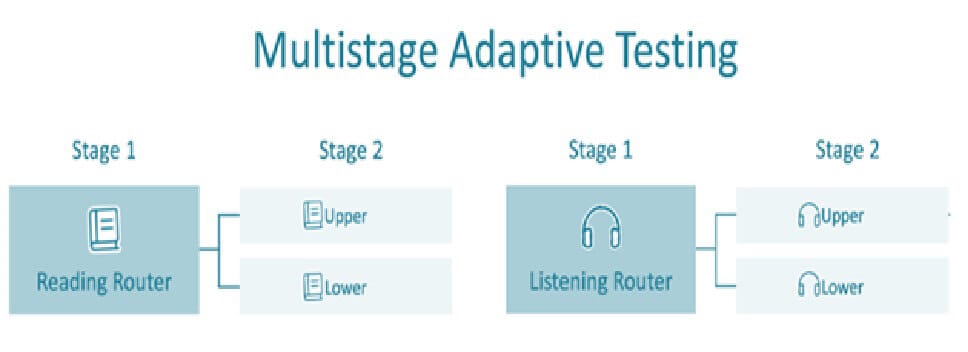
One of the most important updates is the multi-stage adaptive nature of the test, where question difficulty adjusts based on student performance.
TOEFL Revised Pattern Explained (In Depth)
Below is a section-wise breakdown of the revised TOEFL.
1. Reading Section
The Reading section will continue to include traditional passages that feature the complex language typically found in textbooks. It’s now supplemented with passages representing sources like newspapers, magazines, and websites, reflecting a more holistic approach to evaluating academic reading proficiency. Students get about 30 minutes with up to 50 items.
Students are typically tested on:
- Identifying the main idea of a passage
- Understanding supporting details and examples
- Interpreting vocabulary in context
- Recognising relationships between ideas
The passages are designed to reflect real life reading required for studying abroad.
How the Adaptive Feature Works in Reading
After students complete the initial set of reading questions, the test adjusts itself based on performance. Performance on the first part of the section determines the content of the second part of the section to match difficulty with the test taker’s performance.
- Strong performance leads to slightly more challenging questions
- Weaker performance results in questions better aligned to the student’s level
This ensures that students are assessed fairly and not overwhelmed by unnecessary difficulty.
2. Listening Section
Listening tasks measure the ability to understand both academic and nonacademic content. Students get about 29 minutes with up to 47 items. Speakers in listening tasks have accents from three regions of the world: North America, the United Kingdom, and Australia. The Listening section assesses how well students understand spoken English in academic and everyday university situations.
Common listening scenarios include:
- Short academic talks or lectures
- Conversations between students, professors, or university staff
- Announcements and notices related to campus life
The focus is on understanding meaning rather than memorising information.
How the Adaptive Feature Works in Listening
Similar to reading, the listening section also adjusts based on how a student performs in the initial tasks.
- Accurate responses lead to more complex listening content
- Difficulty adjusts downward if students struggle
This allows students to demonstrate their true listening ability without unnecessary pressure.
3. Speaking Section
The Speaking section is designed to test real communication skills, not memorised templates.
Students are expected to:
- Respond to prompts based on what they read or hear
- Organise ideas quickly and logically
- Speak clearly within a limited time
- Show clear pronunciation, understanding, and enunciation.
The tasks closely mirror how students would speak in real settings.
4. Writing Section
The Writing section places strong emphasis on integrated writing.
Students may be required to:
- Read a short academic passage
- Listen to a related audio clip
- Write a response that combines information from both
This tests how well students can process information and express ideas clearly in written form.
Why This Structure Benefits Students
By first understanding what types of questions are asked and then learning how the adaptive system works, students can prepare more strategically and approach the exam with confidence rather than confusion.
How the Revised TOEFL Is Better for Students
The updated TOEFL format offers several advantages:
- Shorter test duration reduces fatigue
- Adaptive testing ensures fair difficulty levels
- Integrated tasks reflect real university learning
- Less focus on rote memorisation
- More emphasis on practical academic communication
Overall, the exam now feels more realistic and student-friendly.
What the Revised TOEFL Means for Students
For students, the revised TOEFL means:
- Strategy matters more than memorising templates
- Understanding concepts is more important than speed
- Consistent practice across skills gives better results
- One weak section does not automatically ruin the entire score
Students who prepare smartly and understand the format clearly are more likely to perform well.
How Innovative Future Steps (IFS) Helps
At Innovative Future Steps (IFS), we help students prepare for the revised TOEFL by:
- Explaining the updated pattern in detail
- Designing preparation strategies aligned with adaptive testing
- Providing targeted practice for each skill
- Offering personalised feedback based on performance
Our goal is to ensure students are not surprised on test day and feel confident with the new format.
Connect with Innovative Future Steps today to prepare for TOEFL the right way.