
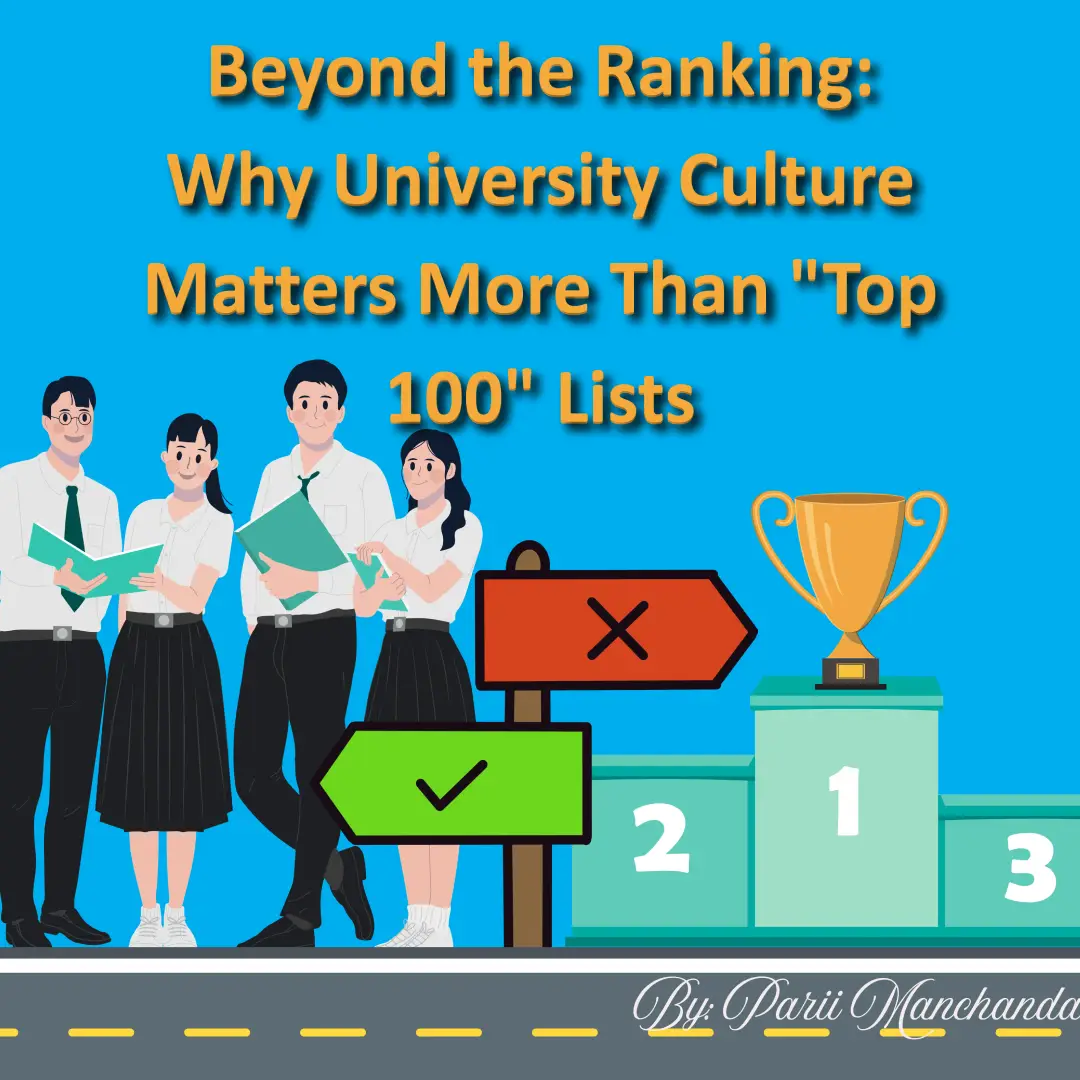
Every admissions season starts the same way in most Indian households: a parent opens the University Rankings, scrolls straight to the top 100, and starts circling names. It feels like due diligence. It feels safe. A high rank is treated as a guarantee, like the number itself is the degree.
“The question isn’t whether to look at the ranking. It’s whether you’re stopping there.”
To be clear, we still tell every family to check the ranking. It’s a legitimate starting filter, a fast way to screen out institutions with weak accreditation, poor research output, or genuine red flags. The problem isn’t the ranking itself. It’s treating it as the final answer instead of the first question. In 2026, employers aren’t hiring “a graduate of a top-100 university.” They’re hiring a graduate of a specific course, with specific skills, who can show specific experience. The ranking gets you a shortlist. It doesn’t tell you which name on that shortlist is actually right for you.
How we’re breaking this down:
Course-level outcomes vs. institution-level prestige
Location ROI: city campus vs. quiet college town
Built-in industry placements vs. trophy rankings
The Ranking Myth
Use the ranking to shortlist. Use the subject data to decide Both matter, in that order
A global ranking is a useful first filter, it’s an aggregate of dozens of metrics: research output, citations, faculty ratios, international reputation surveys, blended into one number that tells you the institution is credible, accredited, and reasonably well-resourced. That’s worth knowing. What it doesn’t tell you is how the one department you’re about to spend three or four years in actually performs.
What the number hides
- A university at #150 overall can run one of the best-connected, highest-employability programs in the country for your exact subject
- A top-50 university’s prestige is often carried by two or three flagship departments, your course may not be one of them
- Subject-specific employment rates and average starting salaries by department are published separately from the headline rank, and rarely checked
What actually predicts outcomes
- Course-specific graduate employment rate within 6–12 months
- Average starting salary for your department, not the university average
- Class sizes and faculty access in your specific program
- How recently the curriculum was updated to match industry needs
Bottom line: Don’t throw out the ranking, use it to build your shortlist, screen for accreditation, and rule out genuine red flags. Then go one layer deeper: check the subject-level ranking and the department’s own published outcome data before you finalise anything. The ranking opens the door; the course data tells you whether to walk through it.
Location ROI
Where you study shapes your degree as much as what you study High impact
| City campus | Quiet college town |
| Higher cost of living | Lower cost of living |
| Dense part-time job market | Limited part-time job market |
| Easy access to internships & industry events | Fewer internships, longer commute needed |
| Strong networking density | Tighter-knit, slower-paced community |
What works in a commercial hub
- Part-time work that’s actually relevant to your field, not just retail or hospitality
- Internships you can take alongside classes without relocating
- Industry meetups, guest lectures, and recruiter events happening on your doorstep
- Easier to build a portfolio or LinkedIn network before you even graduate
What works in a quiet student town
- Significantly lower living costs over 2–4 years
- Closer-knit campus community and traditional student life
- Fewer distractions if your course is research- or lab-heavy
Bottom line: If your course depends on hands-on industry exposure, business, finance, design, media, tech, location can matter as much as the syllabus. Treat it as ROI: is this city actively compounding your employability, or just housing you while you study?
Industry Connections
Mandatory placements beat optional ones The most underrated filter
This is the factor that almost never makes it into a ranking algorithm, and it’s arguably the one employers care about most. A university that builds a mandatory co-op, sandwich year, or structured placement directly into the curriculum is forcing real-world experience into your degree by design, not leaving it up to your own initiative.
What to actually ask universities
- Is industry placement mandatory or optional in this specific course?
- Which companies have participated in the last 12 months, not 5 years ago?
- What percentage of students secure relevant work through the program itself?
- Is there a dedicated placements office for this department, or a generic university-wide one?
Why this beats prestige
- A graduate with 12 months of paid, relevant experience and a real employer reference often beats a candidate with only a degree title
- Employers consistently rank demonstrated experience above institutional name recognition
- Mandatory placements also stress-test whether you actually enjoy the field before you’re fully committed to it
Bottom line: A university that treats employability as part of its core design, not an extracurricular afterthought, is investing in outcomes a ranking algorithm will never directly measure.
Not sure how to balance ranking, course fit, and location for your profile?
We’re not telling you to ignore the ranking, we use it ourselves at the start of every counselling session. What we add is everything the ranking can’t show you: subject-level outcomes, placement structures, and whether the city around the campus will actually work in your favour.
Connect with us today, to get a personalised course and university shortlist ↗